 Search


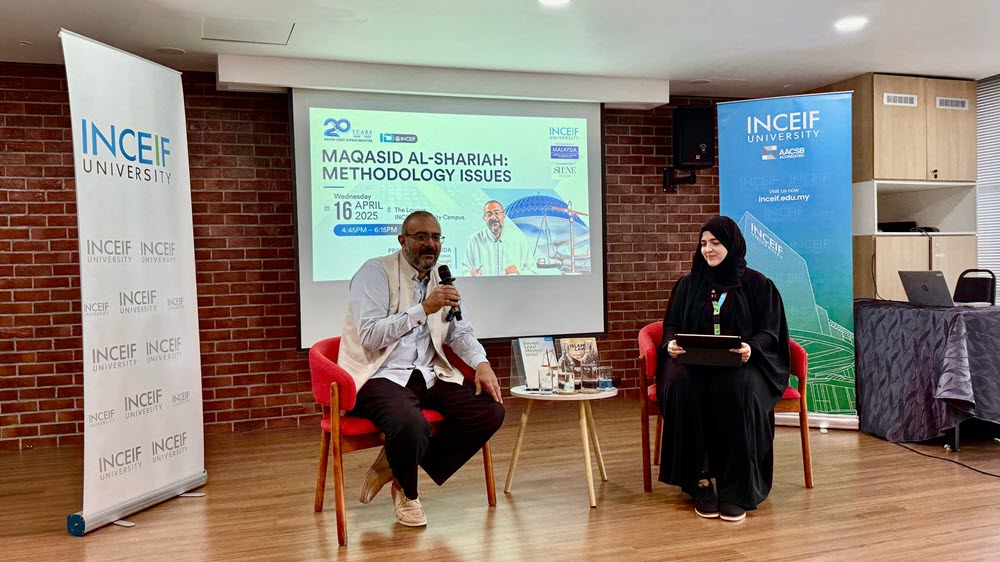
INCEIF Campus, 9 April 2025 – As part of the ID@INCEIF discourse series, INCEIF University was honoured to host Prof Dr Jasser Auda, a globally respected authority on Maqasid Al-Shariah, for an engaging and thought-provoking session titled “Maqasid Al-Shariah: Methodology Issues.” The session drew scholars, students, and professionals eager to delve into the ethical and methodological underpinnings of Islamic law in contemporary society.
Prof Jasser, who is a Visiting Professor at ISTAC-IIUM, began by critically examining the limitations of classical Usul Fiqh in addressing present day social and economic complexities. While acknowledging the foundational role of traditional jurisprudence, he pointed out that a text-centred and precedent-bound approach may at times fall short in realising the deeper objectives of Islamic law—justice, compassion, and the public good. In many academic and professional circles, Maqasid Al-Shariah is cited in principle but rarely operationalised in policy, product design, or impact evaluation.
To bridge this gap, Prof Jasser introduced a novel methodology rooted in systems thinking. Moving away from the idea of a fixed hierarchy among the five well-known objectives—religion, life, intellect, lineage, and wealth—he proposed viewing them as interrelated elements within a dynamic ethical network. This approach draws on complexity science, social sciences, and public policy analysis to account for trade-offs and long-term consequences. Rather than starting with abstract legal texts, it begins with lived human experience and works backward to legal reasoning.
Reframing compliance and impact, Prof Jasser argued that checklists and formal compliance were insufficient. Instead, the true measure of Islamic finance, governance, or policy should be their contribution to human flourishing, harm reduction, and equitable development.
Contextualising Maqasid in Islamic Finance: In fields like Islamic economics and finance, specific Maqasid such as ‘adl (justice), rawaj (circulation), infaq (spending), and the preservation of wealth are central. Understanding these within their respective fields is essential for meaningful application.
To embed Maqasid in practice and education, Prof Jasser proposed a four-step process for embedding Maqasid in our studies and work as below:
- Redefine goals in alignment with Islamic teachings.
- Evaluate real-world impact.
- Empower the ummah to defend ethical integrity and challenge unjust norms.
- Reform education to nurture values-driven knowledge.
His methodology for producing knowledge through Maqasid involves five stages:
- Defining purpose
- Reflective cycles
- Developing conceptual frameworks
- Critical study of literature and reality
- Formulating theories and principles
Central to this methodology is a seven-element framework—concepts, proofs, groups, universal laws, commands, values, and objectives—all interlinked to support holistic and actionable theory-building.
The discourse served as a powerful reminder that Maqasid Al-Shariah is not merely a rhetorical device but a transformative paradigm for ethical reasoning and policy-making in today’s complex world. Prof Jasser’s insights challenged participants to rethink the way Islamic principles are taught, applied, and measured, urging a shift toward a more integrated and human-centric Islamic intellectual tradition.