 Search


Kuala Lumpur, 20 May 2025 – As Malaysia positions itself as a regional hub for sustainable finance, initiatives such as the Bursa Carbon Exchange (BCX) reflect the country’s growing momentum and commitment to climate action.
While carbon markets introduce opportunities, they also raise significant ethical questions that demand careful consideration from an Islamic finance perspective. Do these instruments truly align with Shariah principles, or do they present a modern ethical challenge?
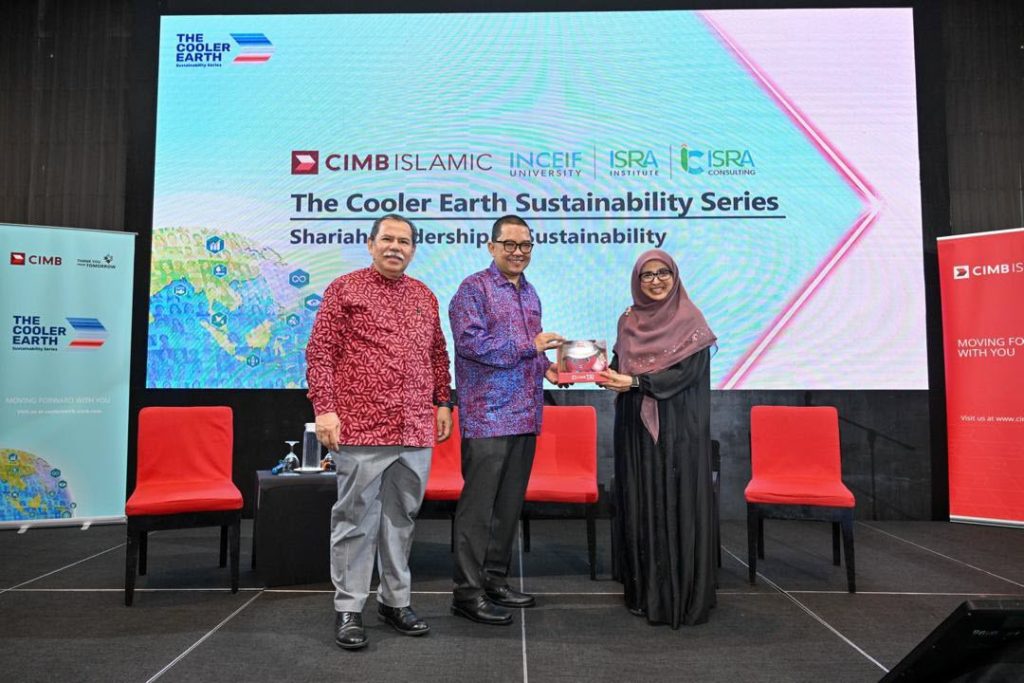
Against this landscape, INCEIF University and its research arm, ISRA Institute – through its Centre of Excellence Islamic Social Finance – in strategic partnership with CIMB Islamic Bank and CIMB Group Sustainability, hosted the Cooler Earth Sustainability Series 2025: Shariah Leadership in Sustainability. The event was attended by policymakers, financial experts, Shariah scholars, and sustainability practitioners to discuss on integrating Islamic principles with environmental and social responsibility.
As Malaysia prepares to implement a national carbon tax in 2026, and global markets introduce carbon tariffs such as the EU’s Carbon Border Adjustment Mechanism, the conference addressed how Islamic finance could respond proactively and ethically to these structural shifts. The half-day conference underscored the urgent need for Malaysia’s financial ecosystem to respond to these emerging global environmental demands.
As the knowledge partner for the conference, INCEIF University worked alongside CIMB Islamic to examine not just the economic potential of such platforms, but also their ethical implications. The conference provided a critical space to explore whether emerging instruments like carbon markets align with Shariah principles or pose new ethical challenges for Islamic finance.
In his welcoming address, INCEIF University President & CEO Professor Emeritus Dato’ Azmi Omar highlighted that while these shifts represented a formidable challenge for Malaysia’s real economy, they were also a call to action for Islamic finance to lead with purpose and principle.
“Where there is pressure, Shariah-anchored finance sees purpose. The core objectives of the Maqaṣid al-Shariah which are public welfare, justice, and stewardship, compel us to protect our planet while creating shared prosperity,” said Dato’ Azmi.
He added that true leadership began with the promises we make and the actions we commit to today.
Highlighting INCEIF’s role as a knowledge hub, Dato’ Azmi reiterated the university’s commitment to advancing impactful financial innovation through policy research, professional education, and advisory services.
CIMB Islamic Bank CEO Ahmad Shahriman Mohd Shariff, in his speech, said in the face of escalating climate risks and social inequality, a values-based approach to sustainability was essential. According to the UN, over 3 billion people are highly vulnerable to climate impacts, and global carbon emissions remain at record highs. These realities demand more than technical solutions; they require moral leadership.
“For us, as an Islamic financial institution, sustainability is not a passing trend; it is a foundational trust – an amanah – grounded in the Qur’anic imperative for humankind to serve as stewards (khalifah) of this Earth. This responsibility compels us to align our financial practices with the principles of justice, balance, and care for creation,” he added.
He also showcased the bank’s leadership in Islamic sustainable finance, including financing over RM100 billion in sustainable initiatives and championing innovative instruments such as:
- Green and Transition Sukuk – Malaysia has issued over RM 24 billion since 2017;
- Waqf-Backed Climate Funds – enabling patient capital for reforestation and agriculture;
- Voluntary Carbon Offsets – through the Shariah-compliant Bursa Carbon Exchange.
“Each financial solution must uphold the ethical imperatives of maslahah (benefit) and amanah. We are committed to aligning with global ESG frameworks while remaining firmly grounded in Islamic values,” Mr Shahriman added.
Delivering the keynote address in her capacity as a member of Bank Negara Malaysia’s Shariah Advisory Council, Dr Marjan Muhammad, Director of Research at ISRA Institute, outlined the ethical and theological foundations of sustainability from an Islamic perspective.
“Sustainability is not a modern invention but a deeply rooted Islamic principle. The values of tawhid (oneness of God), khalifah, and amanah guide us toward balanced and just development.”
She also cautioned against superficial ESG claims and stressed the need for genuine Shariah-aligned tools to measure impact, urging deeper integration between Shariah advisories and business strategies.
While the global ESG and SDG frameworks share common ground with Maqasid al-Shariah – including goals related to eradicating poverty, ensuring access to education and healthcare, promoting equity, and conserving natural resources – they often overlook the spiritual dimension. Maqasid al-Shariah encompasses not only material well-being but also the preservation of religion, an element largely absent in conventional sustainability agendas. As a result, instruments under ESG and SDG umbrellas may incorporate Shariah non-compliant elements such as interest and gambling.
“This divergence stems from the materialistic focus of Western ideologies, whereas Maqasid offers a more holistic model that balances both spiritual and material aspects of human development,” Dr Marjan added.
What distinguishes Malaysia’s approach is its integration of Maqasid within the sustainability agenda. This emphasis is evident in frameworks such as Value-Based Intermediation (VBI), the VBI Scorecard and Impact Toolkit (VBIT), and the Maqasid al-Shariah Guidance.
The conference concluded with a resounding call for collective action from academia, regulators, and industry players. It emphasised the need for technical upskilling, Maqasid-centric Shariah governance, and cross-sector collaboration to address climate change and drive sustainable growth.
Ends.