 Search


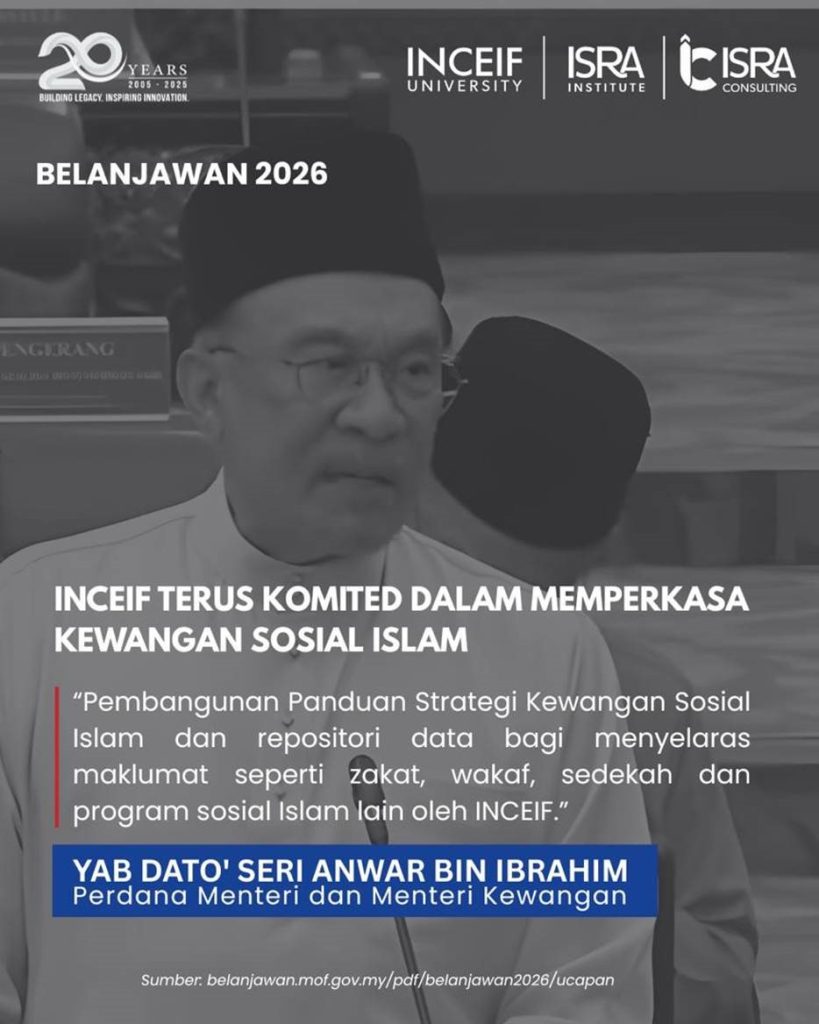
Kuala Lumpur, 10 October 2025 – INCEIF University once again extends its heartfelt gratitude to the Government of Malaysia for the continued recognition and trust, as reflected in the Budget 2026 announcement tabled by Prime Minister and Minister of Finance Dato’ Seri Anwar Ibrahim.
For the third consecutive year, INCEIF has been acknowledged for its leadership in advancing Islamic finance and social economy, with sustained support from the Government underscoring the institution’s pivotal role in shaping Malaysia’s Islamic economics agenda.
This year’s Budget highlights the development of a Guideline on Islamic Social Finance Strategy and a data repository to coordinate key instruments such as zakat, waqf, sadaqah, and other social finance initiatives, a task entrusted to INCEIF University through its research arm, ISRA Institute.
This builds on earlier commitments from Budget 2024 and Budget 2025, to INCEIF and its strategic partners to drive research, innovation, and policy work that align with Maqasid al-Shariah and contribute to inclusive, sustainable growth.
INCEIF University President & CEO Professor Emeritus Dato’ Dr Azmi Omar said the renewed trust reflects the Government’s confidence in INCEIF’s capacity to serve as a national and global thought leader in Islamic finance and economics.
“We are deeply honoured by this continued recognition from the Government of Malaysia. The inclusion of INCEIF in three consecutive national budgets is not only a vote of confidence but also a profound amanah for us to serve with ihsan.
“This support enables us to strengthen our research and innovation ecosystem. We will continue to design evidence-based policies, enhance social finance mechanisms, and champion the universal values of justice, compassion, and shared prosperity enshrined in Maqasid al-Shariah,” Dato’ Azmi said.
He added that INCEIF would continue to build collaborative platforms with academia, policymakers, and industry players to ensure that Islamic economics and finance contribute meaningfully to the nation’s socio-economic resilience.
“Three budgets, one mission which is to advance knowledge and practice that serve humanity and deliver sustainable impact,” Dato’ Azmi said. This year’s Budget 2026 focuses on advancing long-term reforms and tackling near-term challenges to sustain growth and resilience, in line with the 4.5%–5.5% annual growth target, as set out in 13th Malaysia Plan (13MP), from 2026 to 2030.
Anchored by the Ekonomi MADANI framework, Budget 2026 introduces targeted tax reforms, plugging of tax loopholes, green economy incentives, digital upskilling and strategic investments, designed to future-proof the economy while supporting the rakyat.
Ends